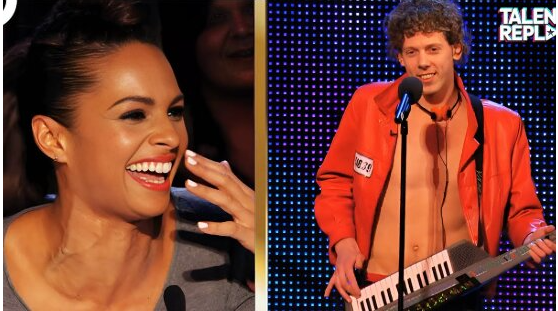
The stage lights dimmed, casting a deep, electric blue hue across the auditorium. The judges sat behind their long mahogany desk, nursing lukewarm coffee, their expressions a familiar cocktail of fatigue and polite skepticism. They had seen it all—singers with soaring ranges, dancers who defied gravity, novelty acts that baffled the imagination. Yet, as the next contestant rolled a modest equipment cart onto the center stage, an unusual shift occurred in the atmosphere. It wasn’t the heavy bass of pre-recorded backing tracks or the glint of an expensive instrument that commanded the room; it was the sheer, magnetic energy of the young man standing behind the console.
His name was Leo, though the audience wouldn’t learn that until later. For now, he was simply a figure in a vintage jacket, flashing a disarming, crooked smile that immediately lowered the collective guard of everyone in the room. Without saying a word into the microphone, his ability to mix music with personality made his audition unforgettable.
The Power of Presence
In the world of performing arts, technical proficiency is often mistaken for artistry. Competitors can spend years drilling scales, practicing transitions, and perfecting beatmatching until their sets are surgically clean. But perfection, while impressive, can sometimes feel cold and distant. Leo understood something far more profound: music is not merely an auditory experience; it is an emotional exchange.
As he adjusted his headphones, he didn’t stare blankly at his mixer. Instead, he looked up, caught the eye of the head judge, and offered a quick, conversational nod.
“Hey everyone,” he said, his voice casual and warm, devoid of the nervous pitch that plagued most contestants. “Before I drop the first track, I just want to say I’m dedicating this set to anyone who’s ever tried to build something cool out of spare parts and pure stubbornness.”
Right then and there, the audition transformed. It stopped being a high-stakes corporate evaluation and started feeling like an intimate session in a crowded, buzzing basement club. His personality wasn’t masked behind layers of electronic distortion or aloof posture; it was woven directly into the fabric of his introduction.
Weaving Story Through Sound
When Leo finally pressed play, the room didn’t just hear a song—they felt a narrative unfold. His mixing style was eclectic, fearless, and deeply autobiographical. Instead of sticking rigidly to a single genre, he took disparate musical epochs and forced them into a vibrant conversation.
-
The Nostalgic Hook: He opened with a soulful, crackling vinyl sample from a 1970s jazz record, instantly evoking a sense of warmth and history.
-
The Modern Pulse: Seamlessly, he layered a crisp, contemporary hip-hop beat underneath, bridging decades with effortless rhythm.
-
The Unexpected Twist: Just as the judges were settling into the groove, he dropped in a cheeky, sped-up vocal snippet of a vintage cartoon line, injecting a dose of humor that made the entire audience chuckle.
What made the transition remarkable wasn’t just the technical beatmatching—though the audio alignment was flawless. It was the attitude behind it. Every time he dropped a heavy bassline or twisted a filter knob, his body language mirrored the shift. He smiled at the drop, grooved naturally to the counter-rhythms, and occasionally mouthed the lyrics with a theatrical flair that brought the room to life. He wasn’t just manipulating tracks; he was hosting a party, and everyone in the auditorium was invited.
Winning Over the Panel
Midway through the set, a subtle transformation took place at the judges’ table. The weary posture vanished. The lead judge, known for a notoriously sharp tongue and a low tolerance for gimmicks, was nodding rhythmically, a reluctant grin breaking across her face. Another judge was tapping his pen against the desk in strict adherence to Leo’s syncopated rhythm.
This is the ultimate triumph of blending character with craft. Anyone can learn to beatmatch with enough practice, but you cannot teach charisma. You cannot program authenticity into a MIDI controller. Leo infused every bar with his unique spirit—playful, ambitious, sharp, and deeply passionate. When he hit a momentary audio loop, rather than panicking or freezing up, he leaned into the glitch, turned it into a dynamic build-up, and threw his hands up to cue the crowd for the drop. The resulting wave of energy swept through the auditorium like a physical breeze.
A Lasting Impression
When the final track faded out, leaving a lingering echo that bounced off the high rafters, the silence lasted for barely a second before the room erupted. The audience was on its feet, clapping and cheering, while the judges exchanged wide-eyed looks of absolute delight.
“I don’t even care about technical critiques right now,” the head judge confessed, leaning into her microphone, her voice brimming with genuine excitement. “You walked in here, you owned every single square inch of this stage, and you made us feel alive. That wasn’t just an audition; that was a masterclass in how to connect with people.”
Leo simply smiled, gave a polite bow, and tapped his heart in gratitude. He hadn’t just played a good set; he had left an indelible imprint on the room. Through his hands, the equipment became an extension of his soul, proving that the greatest performances are not born from technical perfection alone, but from the radiant, unmistakable power of human personality.